


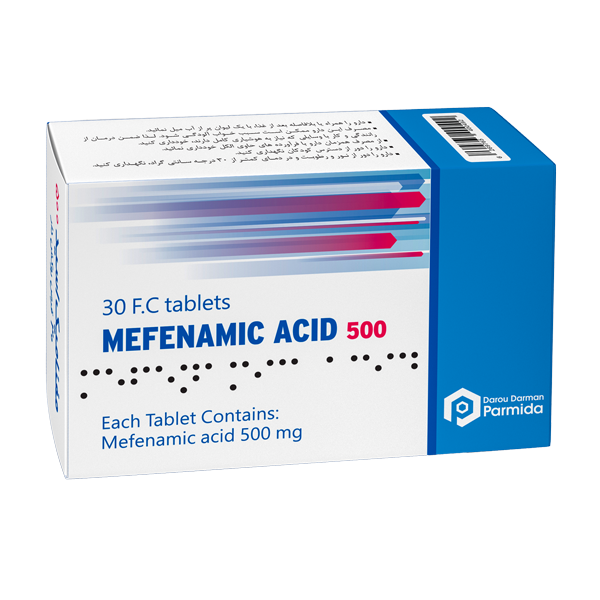
Mefenamic Acid 500 mg
Produced for the First Time in Iran by Darou Darman Parmida
Helps relieve: menstrual pain (dysmenorrhea), muscle, joint and rheumatic pain, headache, toothache, and pain after surgery and childbirth.
Bioequivalent to the Reference Product
Bioequivalence demonstrated
A First in Iran
The first Mefenamic Acid 500 mg produced in Iran, by Darou Darman Parmida
500 mg Strength
For moderate to severe pain
Analgesic and Anti-Inflammatory
Relieves menstrual, muscle, joint, rheumatic, dental and post-operative pain
Why Parmida Mefenamic Acid 500 mg?
Backed by Science, Trusted for Quality
Bioequivalent to the Reference Product
Bioequivalence studies have shown that this product is comparable to the reference product in the rate and extent of absorption of the active ingredient, and can therefore provide similar therapeutic efficacy.
Iran’s First Mefenamic Acid 500 mg
Darou Darman Parmida was the first company in Iran to produce and supply mefenamic acid at the 500 mg strength, making a higher therapeutic dose available in line with clinical needs.
500 mg: More Effective Pain Control
The 500 mg strength provides an appropriate amount of active ingredient for moderate to severe pain where a stronger analgesic and anti-inflammatory effect is needed.
Analgesic and Anti-Inflammatory Action
By inhibiting the production of prostaglandins, the substances that cause pain and inflammation, mefenamic acid helps reduce pain and inflammation.
Active Ingredient
Pain Control with Anti-Inflammatory Action

Mefenamic Acid
NSAID · Fenamate classA non-steroidal anti-inflammatory drug (NSAID) of the fenamate class that relieves pain by reducing the production of substances that cause pain and inflammation.
Mechanism of Action
During pain and inflammation, the body produces prostaglandins, which stimulate pain receptors. By inhibiting the COX-1 and COX-2 enzymes, mefenamic acid reduces prostaglandin production and thereby controls pain and inflammation.
In simple terms: prostaglandins are the body’s pain messengers; mefenamic acid reduces these messages and lowers the intensity of pain.
Pharmacology
Well absorbed after oral administration, metabolized in the liver and excreted mainly by the kidneys. Its analgesic effect usually appears within a few hours of taking it.
Scientific Evidence
Bioequivalence studies have shown that Darou Darman Parmida’s Mefenamic Acid 500 mg is comparable to the reference product in the rate and extent of absorption of the active ingredient.
Dosage
Usual Adult Dose
Initial Dose: 500 mg
Then 250 to 500 mg every 6 to 8 hours as needed, as directed by your physician.
With or After Food
Taking it with or after food reduces the chance of stomach discomfort.
Important
Do not exceed the prescribed dose or duration. This is a prescription medicine; use only as directed by your physician.

FAQ
Good to Know
What is Mefenamic Acid 500 mg?
Mefenamic acid is an analgesic and anti-inflammatory medicine that helps reduce pain and inflammation. It belongs to the non-steroidal anti-inflammatory drug (NSAID) class.
Why 500 mg?
The 500 mg strength provides an appropriate amount of active ingredient to help control moderate to severe pain and is used when a stronger analgesic and anti-inflammatory effect is needed.
Is Parmida Mefenamic Acid 500 mg comparable to the reference product?
Yes. It has been evaluated in bioequivalence studies, which show that it is comparable to the reference product in the rate and extent of absorption of the active ingredient.
When is the best time to take mefenamic acid?
To reduce the chance of stomach discomfort, it is best taken with or after food.
Is mefenamic acid effective for menstrual pain?
Yes. Menstrual pain is largely related to increased prostaglandin production. By reducing these substances, mefenamic acid can help relieve menstrual pain and cramps.
Is mefenamic acid just a painkiller?
No. In addition to relieving pain, mefenamic acid has an anti-inflammatory effect, helping to reduce inflammatory processes in the body.
Can mefenamic acid be taken long-term?
Long-term use of NSAIDs can increase the risk of certain side effects. It should therefore be taken as directed.
Who should use mefenamic acid with caution?
People with a history of stomach ulcers or bleeding, kidney disease, or sensitivity to anti-inflammatory medicines should consult a physician or pharmacist before use.


Leave A Comment